Haiti Arrival Card — iKat Electronic Form in English
Complete your iKat electronic form for Haiti in English with our online form. Submit your application at the earliest 72 hours before travel: we check your details and file your form.
Welcome to Haiti
The Citadelle Laferrière, the beaches of the Côte-des-Arcadins, the colourful streets of Jacmel: the "Pearl of the Antilles" has plenty to amaze travellers. Before you go, one formality not to forget: the iKat, the electronic entry and exit form run by the MICT and the DIE. It is required for all travellers entering or leaving Haiti, Haitians and children included. Free of charge, it is completed at the earliest 72 hours before travel, and again for every trip.
For every trip
A form to complete again for every trip
The iKat is required for all travellers entering or leaving Haiti. It is completed at the earliest 72 hours before travel: the form's calendar only accepts a travel date within the coming days.
One form per traveller: children included, everyone has their own. There is no joint family declaration.
For every trip: you must complete the form for each new trip, even if you have travelled before.
The ArrivalCards solution: submit your application once your flight is known. We prepare and check your form, file it, then send you the confirmation.
Key points
At the earliest 72 hours before travel, one form per traveller, to be completed again for every trip.
Who must complete the iKat?
The iKat concerns all travellers entering or leaving Haiti, Haitians and foreigners alike, children included. It does not replace a visa: check the entry requirements for your nationality.
Foreign travellers
Tourists, business travellers, students: all foreigners complete the iKat, including those exempt from a visa.
Haitian nationals
Haitians complete it too: no exemption is granted.
Children and minors
Every child has their own form. For a minor, you must enter the details of the person accompanying them (relationship, nationality…).
Nationalities that need a visa
A visa is required before departure for nationals of the Dominican Republic, Panama, Colombia, Cuba, Syria, Libya, Iran, Vietnam and Yemen. The iKat does not replace it.
Frequent travellers
The form must be completed again for every trip, even if you have already completed an iKat.
Required Information Table
| INFORMATION TO PROVIDE | PERSONAL DATA |
|---|---|
| IDENTITY | Surname, Given name, Sex, Date of birth, Nationality, Country of birth, Unique identification number (optional) |
| PASSPORT AND MARITAL STATUS | Passport number and expiry date, Marital status (single, married, divorced, widowed) |
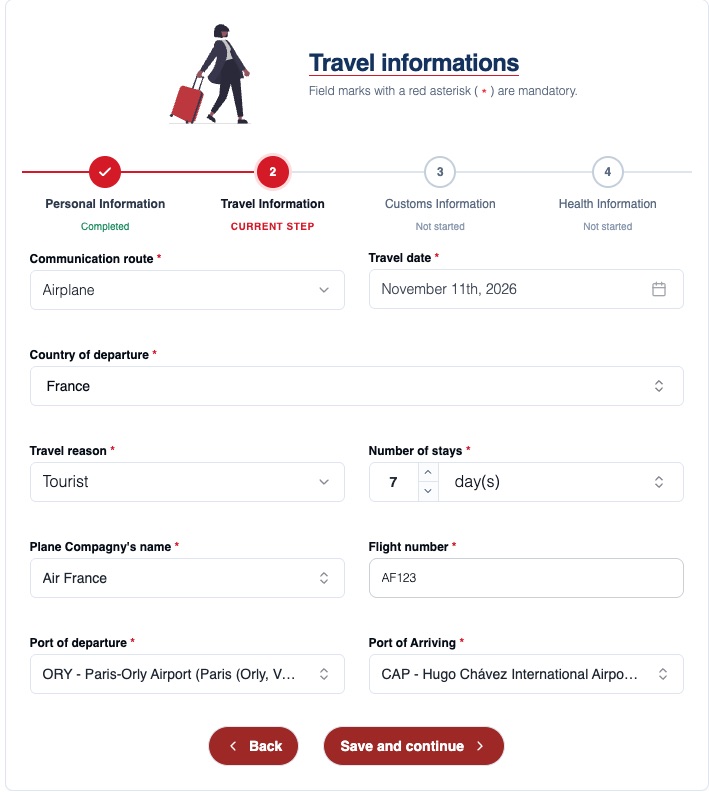
| TRAVEL | Means of transport (air, land, sea), Date of travel, Country of departure, Purpose (work, business, tourism, study, health, other), Length of stay, Airline, Flight number, Departure and arrival airports |
| ACCOMMODATION | Type of accommodation (house rental, hotel, personal residence, Airbnb, other). Hotel: hotel name only. Other types: full address (number and street, commune, department) |
| CUSTOMS | Goods to declare, Cash or monetary instruments of 400,000 gourdes or USD 10,000 or more, Meat, plants, agricultural products, live animals, pharmaceutical products, cigarettes, cigars, alcoholic drinks, Other items |
| HEALTH | Unusual signs or symptoms, now or in the last 7 days, Countries visited or transited in the last 21 days (1 to 3), Emergency contact and their phone number |
| CONTACT DETAILS | Email address (the form and the personal code are sent there), Country of residence, Phone number |
| MINORS AND DECLARATION | For a minor: details of the person accompanying them (relationship, nationality…), Final declaration on honour |
Documents to complete the iKat
Gather these items for each traveller before you start: every detail must match your passport.
- Passport (number, expiry date, nationality, date of birth)
- Marital status: single, married, divorced or widowed
- Date of travel, country of departure, purpose and length of stay
- Airline, flight number, departure and arrival airports
- Accommodation: hotel name, or full address for any other type of accommodation
- Country of residence and phone number
- Emergency contact with their phone number
- A valid personal email address
Customs and health
What the iKat asks about customs and health
Steps 3 and 4 of the iKat replace the former paper customs and health declarations. The form ends with a declaration on honour: the information must be accurate, under penalty of the sanctions provided by law.
Cash: the form asks whether you are carrying cash or monetary instruments of 400,000 gourdes or USD 10,000 or more.
Health: you are asked whether you have any unusual signs or symptoms, now or in the last 7 days, and which countries (1 to 3) you have visited or transited in the last 21 days.
Emergency contact: you enter a person to contact in an emergency, with their phone number.
- Goods to declare
- Cash or monetary instruments of 400,000 gourdes or USD 10,000 or more
- Meat, plants, agricultural products or live animals
- Pharmaceutical products
- Cigarettes, cigars or alcoholic drinks
- Any other item to declare
When should I complete the iKat?
The iKat is completed at the earliest 72 hours before travel, and again for every trip. If you have not completed it in advance, you will have to do so before the checkpoints, which complicates the journey.
Earliest
At the earliest 72 hours before travel
Optimal
As soon as you are within the 72-hour window, once your flight number is known
Latest
Before departure, so you have your QR code with you
iKat validity
Each form is linked to one traveller and one trip.
Duration
Valid for the declared trip: to be completed again for every trip
Entries
One form per traveller and per trip
Extension
Can be changed with the code received by email and the passport number, as long as immigration has not reviewed it
Travelling to Haiti with the iKat
The process is smoother if your form is ready before departure.
- 1
Before departure
Download the PDF with the QR code for each traveller and keep it on your phone or print it.
- 2
At the checkpoints
The health and customs authorities ask for the QR code on arrival. Keep it within reach.
- 3
When leaving Haiti
The QR code is requested again when you leave the country: keep it for the whole stay.
- 4
If your dates change
With the code received by email and your passport number, you can change the form as long as immigration has not reviewed it. After that, a new form must be created.
Places to visit in Haiti

Haiti
The Citadelle Laferrière, a monumental fortress perched in the northern mountains near Cap-Haïtien, dominates the landscape alongside the nearby Sans-Souci palace.
Île-à-Vache, a small island off Les Cayes, charms visitors with quiet beaches and fishing villages.
The Côte-des-Arcadins, north of Port-au-Prince, is lined with sandy beaches and turquoise water.
Jacmel, an art town of colourful façades, is known for its colonial-style houses and craft workshops.
Bassin Bleu, near Jacmel, strings together turquoise pools and waterfalls in a green setting.
Common mistakes with the iKat
A few oversights can complicate your trip: here are the most common.
Confusing the iKat with a visa
The iKat is not a visa: it does not replace a visa if your nationality requires one.
Completing it too early
The form only accepts a travel date within roughly the next 72 hours: there is no point starting weeks ahead.
Grouping the whole family
There is no family form: every traveller, children included, completes their own.
Entering the accommodation incorrectly
For a hotel, only the name is requested. For any other type of accommodation, give the full address: number and street, commune, department.
Forgetting the QR code
The QR code is requested on arrival and when leaving the country. Keep it on your phone or print it.
Haiti arrival card information
What is the iKat?
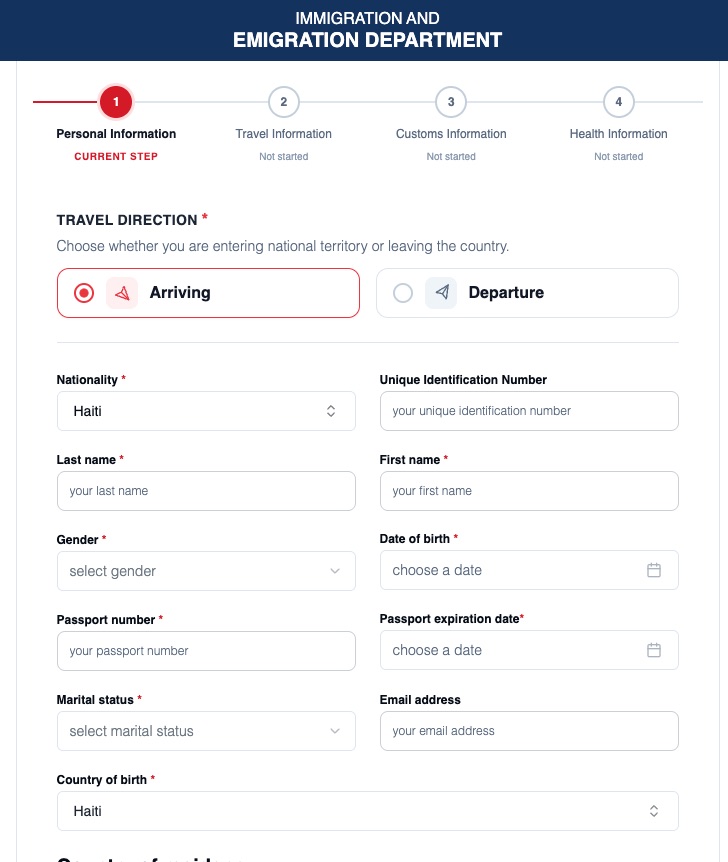
The iKat is the electronic entry and exit form of the Republic of Haiti. Its name combines an "i" and "Kat", the Haitian Creole word for "card". It is run by the Ministry of the Interior and Territorial Collectivities (MICT) and the Immigration and Emigration Directorate (DIE), and it replaces the former paper forms: personal information, travel information, customs declaration and health declaration. It is completed in four steps: personal information, travel information, customs, health. At the end you receive a PDF with a QR code and a personal code sent by email.
Which nationalities are concerned?
All travellers entering or leaving Haiti, Haitians and foreigners alike, children included: everyone completes their own form, and it must be completed again for every trip. The iKat does not replace a visa. A visa is required before departure for nationals of the Dominican Republic, Panama, Colombia, Cuba, Syria, Libya, Iran, Vietnam and Yemen. Check the entry requirements that apply to your nationality before you travel.
Which entry points are concerned?
The form covers travel by air, by land and by sea. International airports include Toussaint Louverture airport in Port-au-Prince (PAP) and Cap-Haïtien International Airport (CAP).
Frequently Asked Questions — Haiti
What is the Haiti iKat?
The iKat is the electronic entry and exit form of the Republic of Haiti, run by the Ministry of the Interior and Territorial Collectivities (MICT) and the Immigration and Emigration Directorate (DIE). It brings together personal information, travel information, the customs declaration and the health declaration. It is not a visa.
What information does the iKat ask for?
Four steps: your personal information (identity, passport, marital status, accommodation), your travel information (transport, date, purpose, flight), customs (cash, goods) and health (symptoms, countries visited, emergency contact), followed by a declaration on honour.
Who must complete the iKat?
All travellers entering or leaving Haiti, Haitians and foreigners alike, children included. There is no exemption.
Do I need the iKat if I do not need a visa?
Yes. The iKat is independent of the visa: travellers exempt from a visa must complete it too. Conversely, it does not replace a visa if your nationality requires one. A visa is required before departure for nationals of the Dominican Republic, Panama, Colombia, Cuba, Syria, Libya, Iran, Vietnam and Yemen.
How long before my trip can I complete the iKat?
At the earliest 72 hours before travel: the form's calendar only accepts a travel date within the coming days. It must be completed again for every trip. On ArrivalCards, submit your application as soon as your flight is known and you are within this window.
How much does the iKat cost?
The form is free: there are no government fees. On ArrivalCards, the service fee is €29 incl. VAT per form issued, excluding any consular fees. This fee includes the guided English-language form, verification of your details, submission and support from our team. The USD 10 tourist fee that non-residents pay on arrival is separate from the iKat.
Can I declare my family on the same form?
No. Every traveller, children included, completes their own form. For a minor, you must enter the details of the person accompanying them (relationship, nationality…). There is no joint family declaration.
What do I receive, and do I need to print it?
At the end you receive a PDF with a QR code, and a personal code sent by email. The health and customs authorities ask for the QR code on arrival and when leaving the country. You can show it printed or on your phone.
Can I change my form?
Yes, with the code received by email and your passport number, for example if your flight date changes. A change is only possible as long as the form has not been reviewed by immigration. After that, a new form must be created.
What other requirements apply for travelling to Haiti?
Your passport must be valid for at least 6 months after your planned return date. Non-residents pay a USD 10 tourist fee on arrival. For a longer stay, a residence permit is requested from the Immigration and Emigration Directorate in Port-au-Prince. Also check the travel advice published by France Diplomatie.
How It Works
Simple, fast, and stress-free.
Fill in the online form
Complete our secure form with your personal information and travel details
Receive your arrival card by email
We process your application and send your electronic arrival card directly to your inbox
Present your card upon arrival
Upon arrival, simply present your electronic card to immigration authorities
Document Timeline
History and evolution of the document.
Before the iKat
Travellers complete several paper forms: personal information, travel information, customs declaration and health declaration.
Before the iKat
Travellers complete several paper forms: personal information, travel information, customs declaration and health declaration.
One single step
The MICT and the DIE bring these forms together in the iKat, a single electronic form in four steps: personal, travel, customs, health.
One single step
The MICT and the DIE bring these forms together in the iKat, a single electronic form in four steps: personal, travel, customs, health.
One form per traveller
Every traveller, children included, completes their own form. No other document has to be completed on arrival.
One form per traveller
Every traveller, children included, completes their own form. No other document has to be completed on arrival.
For every trip
The form must be completed again for every trip. At the end you receive a PDF with a QR code and a personal code sent by email.
For every trip
The form must be completed again for every trip. At the end you receive a PDF with a QR code and a personal code sent by email.
Today
The iKat is mandatory and is completed at the earliest 72 hours before travel. ArrivalCards prepares, checks and files your form for you.
Today
The iKat is mandatory and is completed at the earliest 72 hours before travel. ArrivalCards prepares, checks and files your form for you.
A reliable and secure service.
Processing Time
Your arrival card is typically processed within 24 hours. We recommend applying at least 3 days before your travel date.
Requirements
Valid passport with at least 6 months validity, recent passport photo, travel itinerary, and accommodation details.
Fees
The service fee is €29 incl. tax per arrival card issued, excluding any consular fees. This covers form translation, application verification, and customer support.
Sources
- Ministère de l'Intérieur et des Collectivités territoriales (MICT) / Direction de l'immigration et de l'émigration (DIE) — Formulaire électronique d'entrée et de sortie iKat
- Ambassade d'Haïti à Washington — Tourist Visa
- France Diplomatie — Haïti, entrée / séjour
Information checked in November 2026